Showing posts with label Banstead Downs. Show all posts
Showing posts with label Banstead Downs. Show all posts
Thursday, 22 November 2018
Belmont and Banstead Downs
At my parents' this morning, two Redwings were feeding in a berry-laden tree in the car park as I headed for a stroll around Banstead Downs. The biggest surprise during this excursion was a female Reed Bunting which emerged from the south end of the current sheep pen - the rank vegetation in this area looks rather good at the moment. A Lesser Redpoll was on the golf course side of the railway and other species encountered included a party of three Bullfinches, some 60 Long-tailed Tits in various flocks, 20 Redwings, nine Goldcrests and a flyover Common Gull.

Friday, 8 June 2018
Canons Farm, Banstead Woods, Banstead Downs and Sutton
A short walk around Canons late morning with Josh B featured Bullfinch, Yellowhammer, Goldcrest feeding young, Nuthatch and a handful of Linnets. While in the Rambler's Rest garden (Banstead Woods sector) with Paul G and Linda M at lunchtime, two Coal Tits and a Goldcrest were calling in the pines. Stopping off at my parents', a Whitethroat was singing from adjacent Banstead Downs and while dropping friends off from a trip to the cinema in the evening, we stopped off in Sutton for a quick look at the resident Peregrine pair.
Sunday, 6 May 2018
Banstead Downs, Banstead, Canons Farm, Banstead Woods and Rainham Marshes
I walked through Banstead Downs to get to the patch for the Banstead Arts Festival Tour, noting a few common warblers on the way. A Pied Wagtail flew over the BP station. It was a very enjoyable walk at the patch despite the lack of unusual migrants. The Wheatear was still in Poultry Field and looked rather like a Greenland race individual. A Little Owl was seen at the farm, along with three Yellowhammers and the busy Nuthatch pair was showing nicely for paritipants in Banstead Woods, where a Treecreeper was again singing in the same area.
Back at Rainham (to pick up my car which had been locked in the previous night - my own stupid fault!), a quick scan revealed four hunting Hobbies, a nice flight view of a singing male Cuckoo and a male Marsh Harrier.
Back at Rainham (to pick up my car which had been locked in the previous night - my own stupid fault!), a quick scan revealed four hunting Hobbies, a nice flight view of a singing male Cuckoo and a male Marsh Harrier.
Thursday, 16 February 2017
Canons Farm, Banstead Woods and Banstead Downs, 16th February 2017
Magnus A and Christian C joined me for a grand tour of the patch, on a changeable but mostly spring-like day, partly thanks to the first singing Yellowhammer of the year that I have heard - my day's highlight. We also located one of the Little Owls and had three Lesser Redpolls of note but once again a blank was drawn on what I am counting as my second concerted Lesser Spotted Woodpecker search of the year, though it is early days and I will continue looking. A look around Banstead Downs in the afternoon produced another two Stonechats, which by the sound of it may have been wintering in an area of young scrub, and a fly-over redpoll but a search of the traditional Firecrest site along the western flank of the golf course produced no hoped-for jewels.
 |
| Stonechat pair at Banstead Downs - rather unusual for the site but they may have been wintering in recent months |
Monday, 13 October 2014
Banstead Downs, October 13th 2014 13:40-16:15
Overcast with light drizzle, F2/3 southwesterly.
| Black-headed Gull | 2 |
| Feral Pigeon | Present |
| Woodpigeon | Present |
| Green Woodpecker | 2 |
| Ring-necked Parakeet | 47 |
| Magpie | Present |
| Jay | Present |
| Jackdaw | Present |
| Carrion Crow | Present |
| Goldcrest | 2 |
| Firecrest | 2 |
| Blue Tit | Present |
| Great Tit | Present |
| Long-tailed Tit | 30 |
| Chiffchaff | 3 |
| Blackcap | 2 |
| Wren | Present |
| Starling | 1 |
| Blackbird | Present |
| Song Thrush | 4 |
| Robin | Present |
| Chaffinch | Present |
| Bullfinch | 1 |
| Greenfinch | 1 |
Tuesday, 26 November 2013
Local birding
I had a treat today in the form of a day off so I thought I'd spend it checking out some sites close to my Surrey home. I started off with Banstead Downs Golf Course where two Firecrests were still in-situ but evaded my efforts at photographing them; in the six winters that I've been watching them there, I have never managed a good shot! I've been wanting to dig out a Caspian Gull at Beddington for some time now but haven't been trying in recent weeks because my scope is off being fixed, I decided to give it a go today anyway (with my old Mighty Midget which I use as a spare) and was very pleased to pick out a first-winter Caspo. It was the first bird my scope landed on when I started looking at the active landfill cell and was a real performer, consistently favouring the part of the tip nearest me and with the fewest other gulls. It seemed quite a playful/inquisitive individual, picking at rocks and debris a lot as well as interacting much with other birds and did several flight circuits of the tip. I finished the day with some time at Canons Farm, less time than I had originally planned (these short winter days are a real pain) but enjoyed catching up with Geoff Barter and seeing a decent flock of around forty Skylarks.


Sunday, 6 January 2013
Firecrest and patch
More rubbish pictures! Spent an enjoyable day birding locally today with Josh, Richard and Peter. We started at Banstead Downs Golf Course where one of the Firecrests showed well - there was probably another calling too. Banstead Woods was the next venue, where we successfully flushed a Woodcock from an area of bracken, this being a patch year tick for me. A Lesser Black-backed Gull flying over was the first of the year on the patch and the Red-legged Partridge showed well in Broadfield before flying to Stoney Nob. Not too bad.


 |
| Firecrest at Banstead Downs Golf Course |
 |
| Lonesome George the Red-legged Partridge in Broadfield |
Sunday, 9 December 2012
The best redpoll ever
For best viewing, click the cog icon, select '1080p' and also choose the full-screen option


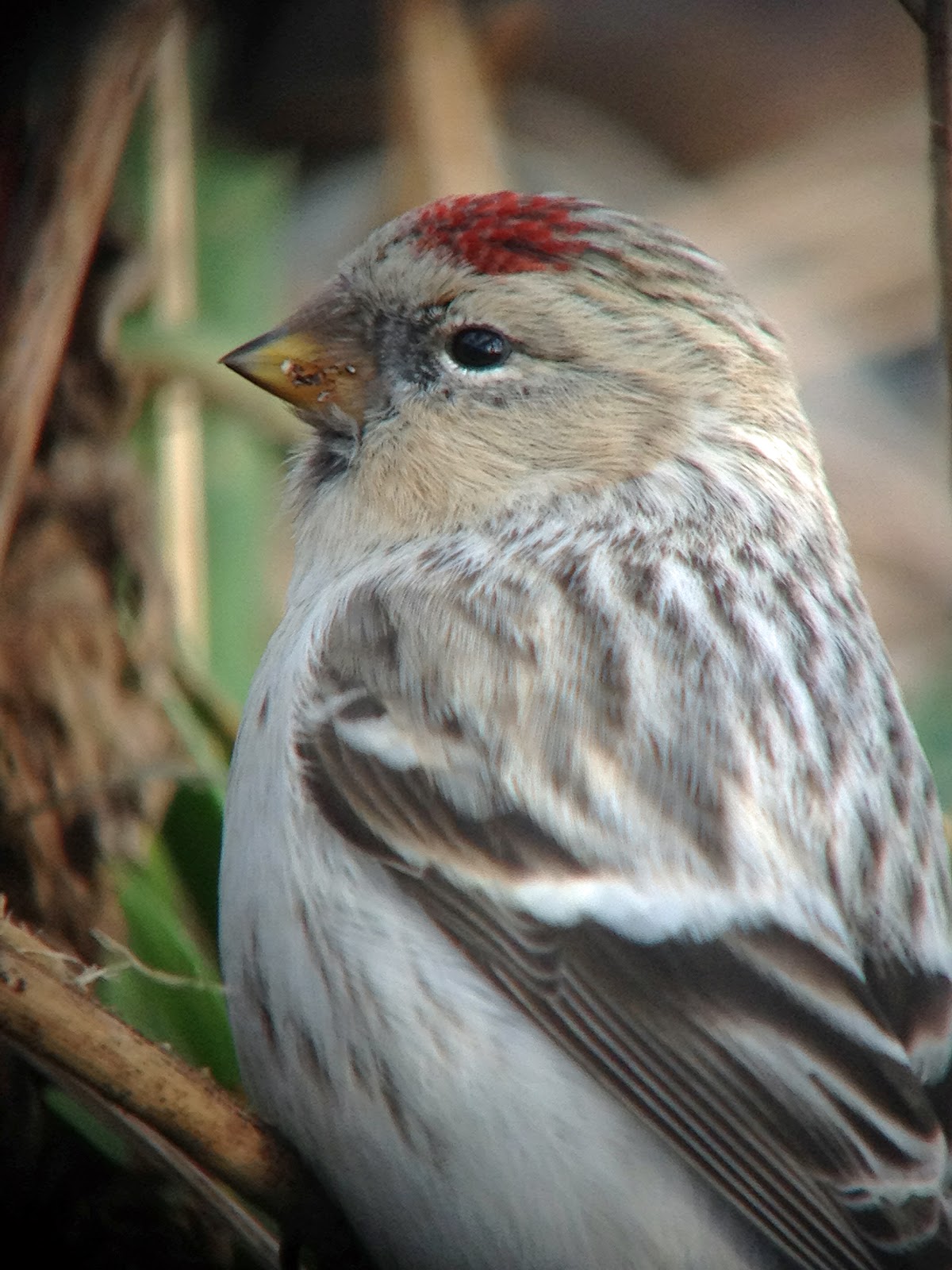


Liam's been staying with me at the weekend for some birding (see yesterday's post for our first outing) and when a HORNEMANN'S ARCTIC REDPOLL came through from Suffolk in the middle of dinner, we were erring as to whether or not to go. It was a bit of a way and we were looking forward to a relaxed day staying local. We started today at Banstead Downs Golf Course, locating at least one of the wintering Firecrests and both independently hearing a 99%-certain Waxwing calling once as it passed over, maybe a hundred feet up. It was then that the redpoll came on the pager; I called Ian to see if he was up for it, and picked him up. We very briefly stopped on Canons Lane to allow Liam to Canons-tick Lapwing, which was a success. A good sign!
The journey was remarkably smooth and we got to Aldeburgh in about two-and-a-half hours. It took me a while to get ready and by the time I started putting my camera over my shoulder and locking the car Ian and Liam had seen the bird well and watched it fly off! Not to worry, though, as it was soon relocated and it didn't exactly prove a challenge to get on or get clear views of, showing virtually no fear of the several-dozen birders admiring it. A true beauty, allowing both its overall striking appearance and more precise features to be observed in exceptional viewing conditions. Happy all round, with no reason for angst about photographers or people getting too close as the bird simply did not care.
Liam's been staying with me at the weekend for some birding (see yesterday's post for our first outing) and when a HORNEMANN'S ARCTIC REDPOLL came through from Suffolk in the middle of dinner, we were erring as to whether or not to go. It was a bit of a way and we were looking forward to a relaxed day staying local. We started today at Banstead Downs Golf Course, locating at least one of the wintering Firecrests and both independently hearing a 99%-certain Waxwing calling once as it passed over, maybe a hundred feet up. It was then that the redpoll came on the pager; I called Ian to see if he was up for it, and picked him up. We very briefly stopped on Canons Lane to allow Liam to Canons-tick Lapwing, which was a success. A good sign!
The journey was remarkably smooth and we got to Aldeburgh in about two-and-a-half hours. It took me a while to get ready and by the time I started putting my camera over my shoulder and locking the car Ian and Liam had seen the bird well and watched it fly off! Not to worry, though, as it was soon relocated and it didn't exactly prove a challenge to get on or get clear views of, showing virtually no fear of the several-dozen birders admiring it. A true beauty, allowing both its overall striking appearance and more precise features to be observed in exceptional viewing conditions. Happy all round, with no reason for angst about photographers or people getting too close as the bird simply did not care.
Saturday, 24 November 2012
Back in business
I've been ill over the last fortnight with chicken pox and been almost completely out of action, instead spending my days sleeping till 2pm then watching TV until 2am, reading a couple of books then going back to sleep. This was only broken by a flying visit to Samphire Hoe Country Park on Monday which simply had to be done because for some reason Desert Warbler has always been near the top of my wish list (it was a dip).
With the physical discomfort over and the spots fading I decided on Friday to break into my normal routine and headed to Banstead Downs Golf Course in the afternoon. This produced two Firecrests, which I was delighted to see as they're one of my favourite birds and their return is reassuring considering the extent of habitat destruction that the golf course has persisted on doing over the last year or two. I initially found wintering Firecrests here in late 2008 and numbers have reached 3-4 before.
Today I went to the patch for the first time in ages. I'd been sorely missing it so was desperate to give it a good go, despite knowing the abysmal forecast. The weather was indeed crap and birding in the conditions was a challenge, but a fly-over Common Snipe made it very worthwhile (only the 2nd record for me/the recording area this year, and the first was a heard-only nighttime record). It was good to reacquaint with the three local birders that were out today and I eagerly await the apparently more comfortable conditions tomorrow.
With the physical discomfort over and the spots fading I decided on Friday to break into my normal routine and headed to Banstead Downs Golf Course in the afternoon. This produced two Firecrests, which I was delighted to see as they're one of my favourite birds and their return is reassuring considering the extent of habitat destruction that the golf course has persisted on doing over the last year or two. I initially found wintering Firecrests here in late 2008 and numbers have reached 3-4 before.
Today I went to the patch for the first time in ages. I'd been sorely missing it so was desperate to give it a good go, despite knowing the abysmal forecast. The weather was indeed crap and birding in the conditions was a challenge, but a fly-over Common Snipe made it very worthwhile (only the 2nd record for me/the recording area this year, and the first was a heard-only nighttime record). It was good to reacquaint with the three local birders that were out today and I eagerly await the apparently more comfortable conditions tomorrow.
 |
| A miserable day, producing a Common Snipe |
Tuesday, 20 March 2012
Batty


Popped to Epsom Common this afternoon to look for Mandarins (of which I found five drakes and four females) and was amazed to see this bat flying around - guessing at Pipistrelle but haven't researched visual bat ID, ideas?
 |
| This drake Mandarin seemed to be dropping water or something from the water on the female's back. Female did several rushes in water, snapping at air (catching insects?) when male following her |
Also notable, this morning as I drove from Canons Farm to college was an Egyptian Goose flying over the A217 at Banstead Downs, in loose association with another goose that was probably also an Egyptian but I didn't get an detail on this other bird.
Saturday, 19 December 2009
Ice, fire and a tick


Very cold weather has struck the south east, and we have all felt (including, it seems, the Staines Brown Shrike).
 Magpie
Couldn't really be bothered to go to Canon's Farm today, in the cold weather, and wanted photos of the Firecrests in the snow so I worked Banstead Downs for the late morning and early afternoon.
At Banstead Downs Golf Course I located 2 Firecrests, 1 of which showed well and I managed a handful of record shots, though nothing spectacular.


The highlight was a very pleasant surprise in the form of 6 Lapwings flying over. A Banstead Downs tick for me (72, and 69 for the site for 2009).
At the eastern part of the golf course I came across 4 Blackcaps, which was a nice surprise. This was 1 male on his own and a pair with another which was unsexed.
 male Blackcap
Thrushes were much in evidence with roughly 30-40 Redwings, 2 Fieldfares and 10-20 Blackbirds. A Meadow Pipit called.

Fieldfare
 Redwing
 Blackbird (1st winter male)
Both Green and Great Spotted Woodpeckers were seen and 2 Bullfinches showed for once.
 Bullfinch
Other bits and pieces included 2 Jays, 1 Coal Tit nearby, 1 Pied Wagtail over and a Common Gull over.
 Long-tailed Tit
Saturday, 21 November 2009
Abberton wader city 21/11/2009
Phil Wallace took me out to Abberton Reservoir today to have a go for the Spotted Sandpiper that had been present for a week, or possibly up to a month ago.
We left just after 0700, at sunrise, and headed straight for the reservoir, arriving at 0830, before the visitor centre was open so we had to start making our way around, permit or no permit. At Wigborough Bay, the surprisingly low water level produced surprising numbers of waders; honestly, you would be forgiven for thinking it was an estuary. Over 20 Avocet were present with 30 or 40 Black-tailed Godwits, about the same number of Ruff, 50-100 Dunlin, a Ringed Plover, a handful of Redshank and about 1500 Golden Plover at one point. 3 Goldeneye were noted here. Raptor wise, 1 Kestrel, 1 Common Buzzard and a frustrating possible Hen Harrier were seen.
We walked for about four miles, unnecessarily, before deciding it would be better if we went back to the car, went to the visitor centre, got a permit and drove around to the other side, so we did. Along these four miles we saw several Meadow Pipits, c.20 Ringed Plover and several more Goldeneye bringing it up to around 10 in total however there was little else new of note.
We signed in at the visitor centre and drove around to the other side, walking about a kilometre to where the bird was meant to have been frequenting. Surprisingly (or perhaps not, considering the rip-off access to a restricted number of people at a time and the huge and confusing site), there were only two other birders there, on the opposite side of a mini-bay, but we could tell where the bird was from where they were looking. At 2 minutes before mid-day we connected with the SPOTTED SANDPIPER, a lifer for both of us (British tick 261 for me (239 for the year)).
After watching it for a few minutes, we attempted to walk closer and around the other side of it in order to get closer views in better light. I heard the bird give the characteristic Common Sandpiper-like (but more drawn out) call and knew it had flown, but when I looked it was still there. I looked again shortly afterwards and it wasn't. We got to the other birders and they said it had flown around the corner. We waited for its return which would happen sooner or later, seeing that where we originally saw it was the only big patch of mud in the area. Another birder appeared and he soon found it just along the shore from us, it must have walked back around and was working it's way back to its favoured feeding spot.
We enjoyed prolonged, good views of it as it fed, occasionally pausing for two or three minutes allowing for a shot before preening, bathing or resuming feeding activities. Then it flew, calling as it went and I managed some reasonable flight shots. It was back where we saw it originally, further away for where we now were. Then a birder came and flushed it. It flew, I got some more shots in flight while it circled before landing near where Phil was stalking and he obtained some brilliant images. It took off abruptly and returned further up the shore again.

Once more it flew back to it's original spot, disappointingly for me, who was waiting for a shot like Phil's, it at the first spot. Then three birders appeared, disappointingly it didn't fly but worked its way slowly towards me, before it actually did come as close as it did to Phil (showing, better than ever the key features for a 1st winter bird: plain terials, barred coverts, yellow legs and shorter tail) and I got some shots before it flew back further up the shore. Score! I was so thrilled after all that waiting and walking!

Also seen briefly (too much so for me to judge it's size and structure) was a Bewick's/Whooper Swan. It had the bill pattern of Whooper but 3 Bewick's were reported there that day. . . a Rock Pipit called and a Black Swan added a splash of the exotic.
We headed back to the car and at c.1440 we headed off to Westcliff-on-Sea to get Phil the Ring-billed Gull. We arrived and parked outside the famous ice-cream parlour and within ten minutes the RING-BILLED GULL and a Mediterranean Gull were among the swarms of Black-headed and Common Gulls which came to bread that a gentleman was throwing to them. Excellent views were had of the Ring-billed as it flew feet above our heads and landed on the sea not too far away before flying off (too dark, really, for pics though). A quick ice-cream then it was time to head home after another brilliant day.
By the way, the Firecrests are still at Banstead Downs Golf Course with a recent count of three. Two showed well on Friday. See nuttypatch.
We left just after 0700, at sunrise, and headed straight for the reservoir, arriving at 0830, before the visitor centre was open so we had to start making our way around, permit or no permit. At Wigborough Bay, the surprisingly low water level produced surprising numbers of waders; honestly, you would be forgiven for thinking it was an estuary. Over 20 Avocet were present with 30 or 40 Black-tailed Godwits, about the same number of Ruff, 50-100 Dunlin, a Ringed Plover, a handful of Redshank and about 1500 Golden Plover at one point. 3 Goldeneye were noted here. Raptor wise, 1 Kestrel, 1 Common Buzzard and a frustrating possible Hen Harrier were seen.
We walked for about four miles, unnecessarily, before deciding it would be better if we went back to the car, went to the visitor centre, got a permit and drove around to the other side, so we did. Along these four miles we saw several Meadow Pipits, c.20 Ringed Plover and several more Goldeneye bringing it up to around 10 in total however there was little else new of note.
We signed in at the visitor centre and drove around to the other side, walking about a kilometre to where the bird was meant to have been frequenting. Surprisingly (or perhaps not, considering the rip-off access to a restricted number of people at a time and the huge and confusing site), there were only two other birders there, on the opposite side of a mini-bay, but we could tell where the bird was from where they were looking. At 2 minutes before mid-day we connected with the SPOTTED SANDPIPER, a lifer for both of us (British tick 261 for me (239 for the year)).
After watching it for a few minutes, we attempted to walk closer and around the other side of it in order to get closer views in better light. I heard the bird give the characteristic Common Sandpiper-like (but more drawn out) call and knew it had flown, but when I looked it was still there. I looked again shortly afterwards and it wasn't. We got to the other birders and they said it had flown around the corner. We waited for its return which would happen sooner or later, seeing that where we originally saw it was the only big patch of mud in the area. Another birder appeared and he soon found it just along the shore from us, it must have walked back around and was working it's way back to its favoured feeding spot.
We enjoyed prolonged, good views of it as it fed, occasionally pausing for two or three minutes allowing for a shot before preening, bathing or resuming feeding activities. Then it flew, calling as it went and I managed some reasonable flight shots. It was back where we saw it originally, further away for where we now were. Then a birder came and flushed it. It flew, I got some more shots in flight while it circled before landing near where Phil was stalking and he obtained some brilliant images. It took off abruptly and returned further up the shore again.


Once more it flew back to it's original spot, disappointingly for me, who was waiting for a shot like Phil's, it at the first spot. Then three birders appeared, disappointingly it didn't fly but worked its way slowly towards me, before it actually did come as close as it did to Phil (showing, better than ever the key features for a 1st winter bird: plain terials, barred coverts, yellow legs and shorter tail) and I got some shots before it flew back further up the shore. Score! I was so thrilled after all that waiting and walking!

Also seen briefly (too much so for me to judge it's size and structure) was a Bewick's/Whooper Swan. It had the bill pattern of Whooper but 3 Bewick's were reported there that day. . . a Rock Pipit called and a Black Swan added a splash of the exotic.
We headed back to the car and at c.1440 we headed off to Westcliff-on-Sea to get Phil the Ring-billed Gull. We arrived and parked outside the famous ice-cream parlour and within ten minutes the RING-BILLED GULL and a Mediterranean Gull were among the swarms of Black-headed and Common Gulls which came to bread that a gentleman was throwing to them. Excellent views were had of the Ring-billed as it flew feet above our heads and landed on the sea not too far away before flying off (too dark, really, for pics though). A quick ice-cream then it was time to head home after another brilliant day.
By the way, the Firecrests are still at Banstead Downs Golf Course with a recent count of three. Two showed well on Friday. See nuttypatch.
Thursday, 5 November 2009
Firecrest delight
A trip today up to Banstead Downs Golf Course was rewarded with the presence of a male and a female Firecrest which showed well near post 678 along the wooded footpath there.
I kept careful track of these birds, their local movements and their numbers last winter and was horrified to watch their numbers rapidly dwindle after habitat destruction at the golf course. I got the support of some local birders and we were approached by a local newspaper on the issue, we ended up getting the front page!
It was a true delight to re-discover these fantastic little birds a short walk from my front door and I hope they have a successful winter at the golf course.
See my local patch blog for more details.
I kept careful track of these birds, their local movements and their numbers last winter and was horrified to watch their numbers rapidly dwindle after habitat destruction at the golf course. I got the support of some local birders and we were approached by a local newspaper on the issue, we ended up getting the front page!
It was a true delight to re-discover these fantastic little birds a short walk from my front door and I hope they have a successful winter at the golf course.
See my local patch blog for more details.
Subscribe to:
Posts (Atom)