It took nearly three hours of careful scanning in the wind but eventually the Shorelark revealed itself in the southeast corner of the Flat Beach, a Sussex tick for me, loosely among a scattering of about 25 Skylarks. I didn't have much time to look for much else but did note four Dark-bellied Brent Geese, two Grey Plovers, 600 or so Golden Plovers, a Knot, a Cetti's Warbler, five Mistle Thrushes and four Rock Pipits.
Showing posts with label Rye Harbour. Show all posts
Showing posts with label Rye Harbour. Show all posts
Saturday, 21 November 2020
Monday, 30 December 2019
Rye Harbour
With the promise of a bright day with a modest wind, Phil and I seized the opportunity to bird Rye Harbour in humane conditions and it was most enjoyable. We spent the whole day doing a slow circuit of the reserve, finishing on 79 species (notable omissions included Linnet and Pintail). 48 Dark-bellied Brent Geese included at least 22 young, while other wildfowl included the juvenile Smew, an adult female Goldeneye, and 'casual' counts of 90 Pochards, 250 Shovelers, 155 Gadwall, 145 Teal, 30 Shelducks and 150 Wigeon. A Merlin low overhead was one of the best moments of the day. A Black-necked Grebe was on the Long Pit, along with a Kingfisher. Waders included a vocal Spotted Redshank, 170 Golden Plovers, 290 Lapwings, 31 Grey Plovers, 300 Dunlin, 24 Ringed Plovers, 30 Redshanks, five Curlew, 285 Oystercatchers and three Turnstones. Other birds included three Bullfinches, seven Reed Buntings, three pairs of Stonechats, a Mistle Thrush, 330 Coots, two Green Woodpeckers, a Great Spotted Woodpecker and 12 Skylarks, of which one broke into song.
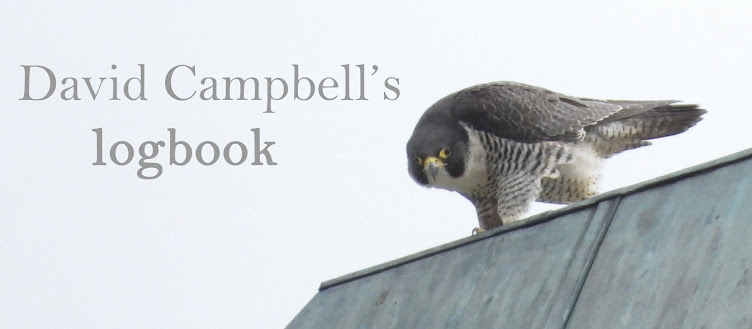
Five Great White Egrets coming to roost were part of a perfect end to the day at Castle Water, with Cetti's Warblers and Water Rails vocal, and around 70 Fieldfares looking for somewhere to roost while an adult male Peregrine defended its kill against a Carrion Crow, and a Sparrowhawk buzzed the 'mini-murmuration' of 300 or so Starlings. Before dusk, a pair of Marsh Harriers patrolled the reedbeds there and a Buzzard flew over.
 |
| Shovelers |
Five Great White Egrets coming to roost were part of a perfect end to the day at Castle Water, with Cetti's Warblers and Water Rails vocal, and around 70 Fieldfares looking for somewhere to roost while an adult male Peregrine defended its kill against a Carrion Crow, and a Sparrowhawk buzzed the 'mini-murmuration' of 300 or so Starlings. Before dusk, a pair of Marsh Harriers patrolled the reedbeds there and a Buzzard flew over.
 |
| Peregrine |

Monday, 9 December 2019
Rye Harbour
A shamefully hurried visit to a gusty Rye Harbour saw me connect with the redhead Smew which has been viewable from the Denny Hide for a few days. It kept drifting out of sight into a distant corner at first, but after a bout of relentless dives it eventually drifted nearer to the hide and took some time out, affording much better views. I didn't have time to do much else, but there were well over 400 Golden Plovers on view, along with 17 Grey Plovers, an adult Dark-bellied Brent Goose and a couple of Pintail, while along the path there was a loose gathering of Reed Buntings and Skylarks. A Rock Pipit flew up from the saltmarsh on the way back to the car.
 |
| redhead Smew |
Friday, 13 September 2019
Kipping's Cross, East Guldeford, The Midrips and Rye Harbour
My short East Sussex break began at Kipping's Cross services with a Red Kite. East Guldeford was frustrating as I couldn't find a legitimate way on to the levels, with singles of Marsh Harrier and Yellow Wagtail the best in my limited watching. Out of curiosity, I popped in to The Midrips, which was even more disappointing. A Marsh Harrier was over the fields at the back and the beach held Turnstone, Ringed Plover and Oystercatcher but the only waders on the pools were three Redshanks. Nine Sandwich Terns and two Gannets were offshore.
Christian joined me for an evening at Rye Harbour, where birds seen included 50 Sandwich Terns, 10 Common Terns, a Kingfisher, three Yellow Wagtails, two Grey Plovers, a Golden Plover, eight Knot, 60 Curlews, 90 Oystercatchers and nine Wigeon, to pick out a few.
Christian joined me for an evening at Rye Harbour, where birds seen included 50 Sandwich Terns, 10 Common Terns, a Kingfisher, three Yellow Wagtails, two Grey Plovers, a Golden Plover, eight Knot, 60 Curlews, 90 Oystercatchers and nine Wigeon, to pick out a few.
Saturday, 20 April 2019
West Worthing, Winchelsea and Rye Harbour
A Meadow Pipit flew over my West Worthing garden as I left for Rye Harbour this morning. En route, a Red Kite flew over as I passed through the fields between Winchelsea and Rye.
By the time I'd arrived at my destination, there was news of two Black-winged Stilts at Dungeness, so I knew I was bound to dip as these were undoubtedly the birds which had been at the harbour for the last couple of days. Nethertheless, as I got out of the car to a beautiful, pleasantly warm day, with Mediterranean Gulls yowling overhead and Whitethroat singing, I felt a currently very welcome serenity and spent three very pleasant hours birdwatching around the reserve. As well as watching the antics of the breeding Sandwich Terns, Mediterranean and Black-headed Gulls, passage waders such as a trio of Spotted Redshanks, a Whimbrel, four Bar-tailed Godwits, a scattering of Dunlin and four Grey Plovers were enjoyed. Avocets, Oystercatchers and Ringed Plovers were of course generously dotted about, along the a Curlew here and there. Three Wheatears included two song-flighting males, something I've not seen in a very long time. Three Little Ringed Plovers flew around excitedly and three Common Terns were a low-key presence. Two Yellow Wagtails flew over, the occasional Swallow zipped through and straggling winter wildfowl included Dark-bellied Brent Goose, Wigeon and Teal. A fine pair of Common Gulls were among the denizens of Ternery Pool. A few Sedge Warblers and Whitethroats, fewer Reed Warblers and five Lesser Whitethroats were in voice, along with three Cetti's Warblers. Fresh in, a migrant Willow Warbler sought refuge in a tiny bush by the red-roofed hut. One of the biggest surprises of the day was a Grey Partridge which erupted from beside the path before alighting a short distance away and giving a few screeches - I'm sure I've never seen one at Rye before. My first Holly Blue of the year passed me while I was trying to get a view of a Lesser Whitethroat.
By the time I'd arrived at my destination, there was news of two Black-winged Stilts at Dungeness, so I knew I was bound to dip as these were undoubtedly the birds which had been at the harbour for the last couple of days. Nethertheless, as I got out of the car to a beautiful, pleasantly warm day, with Mediterranean Gulls yowling overhead and Whitethroat singing, I felt a currently very welcome serenity and spent three very pleasant hours birdwatching around the reserve. As well as watching the antics of the breeding Sandwich Terns, Mediterranean and Black-headed Gulls, passage waders such as a trio of Spotted Redshanks, a Whimbrel, four Bar-tailed Godwits, a scattering of Dunlin and four Grey Plovers were enjoyed. Avocets, Oystercatchers and Ringed Plovers were of course generously dotted about, along the a Curlew here and there. Three Wheatears included two song-flighting males, something I've not seen in a very long time. Three Little Ringed Plovers flew around excitedly and three Common Terns were a low-key presence. Two Yellow Wagtails flew over, the occasional Swallow zipped through and straggling winter wildfowl included Dark-bellied Brent Goose, Wigeon and Teal. A fine pair of Common Gulls were among the denizens of Ternery Pool. A few Sedge Warblers and Whitethroats, fewer Reed Warblers and five Lesser Whitethroats were in voice, along with three Cetti's Warblers. Fresh in, a migrant Willow Warbler sought refuge in a tiny bush by the red-roofed hut. One of the biggest surprises of the day was a Grey Partridge which erupted from beside the path before alighting a short distance away and giving a few screeches - I'm sure I've never seen one at Rye before. My first Holly Blue of the year passed me while I was trying to get a view of a Lesser Whitethroat.
 |
| Spotted Redshanks at Rye Harbour |
 |
| Bar-tailed Godwits at Rye Harbour |
 |
| male Wheatear at Rye Harbour |
Thursday, 4 April 2019
Goring Gap and Rye Harbour
An excellent 4-hour seawatch from the car at Goring Gap this morning produced 10 Manx Shearwaters west (a group of eight, then two singletons) and three Arctic Skuas east (both year ticks), as well as five Bonxies, 232 Dark-bellied Brent Geese, 33 Common Scoters, a Shelduck, eight Red-throated Divers, 28 Fulmars, two Great Crested Grebes, eight Kittiwakes, a Guillemot, 37 Sandwich Terns and an eastward flurry of 24 Mediterranean Gulls. It was great to witness a busy sea again, and the onset of spring migration along the Channel!
Later, Gareth and I headed to Rye Harbour for a late session. We started with a scope around the Flat Beach from the John Gooders Hide. Surprisingly, we picked up the three Twite feeding to the south of the hide - surely these birds with move to their breeding grounds soon! Singles of Bar-tailed Godwit, Knot and Turnstone lurked around the edges, along with small numbers of Grey Plover, Ringed Plover and Dunlin. Black-headed and Mediterranean Gulls argued the toss as on their breeding islands, while Avocets (a year tick for me!) sweeped the water's surface close to the hide. Lone Dark-bellied Brent Goose and Egyptian Goose were also present.
We moved on to Castle Water, where a Willow Warbler was singing behind the viewpoint and a more distant Sedge Warbler was heard chattering away. A group of around 40 hirundines headed through, mostly Sand Martins but with around five Swallows were in the midst, the latter being my first of 2019. The Bittern we'd heard booming on our last visit thankfully erupted from nearby reeds before long then proceeded to boom a couple of times. A couple of Bearded Tits were heard calling but remained unseen. A Marsh Harrier patrolled the reedbeds, and we also logged a couple of Cetti's Warblers and a Peregrine.
Later, Gareth and I headed to Rye Harbour for a late session. We started with a scope around the Flat Beach from the John Gooders Hide. Surprisingly, we picked up the three Twite feeding to the south of the hide - surely these birds with move to their breeding grounds soon! Singles of Bar-tailed Godwit, Knot and Turnstone lurked around the edges, along with small numbers of Grey Plover, Ringed Plover and Dunlin. Black-headed and Mediterranean Gulls argued the toss as on their breeding islands, while Avocets (a year tick for me!) sweeped the water's surface close to the hide. Lone Dark-bellied Brent Goose and Egyptian Goose were also present.
 |
| Avocet at Rye Harbour |
We moved on to Castle Water, where a Willow Warbler was singing behind the viewpoint and a more distant Sedge Warbler was heard chattering away. A group of around 40 hirundines headed through, mostly Sand Martins but with around five Swallows were in the midst, the latter being my first of 2019. The Bittern we'd heard booming on our last visit thankfully erupted from nearby reeds before long then proceeded to boom a couple of times. A couple of Bearded Tits were heard calling but remained unseen. A Marsh Harrier patrolled the reedbeds, and we also logged a couple of Cetti's Warblers and a Peregrine.
Thursday, 28 March 2019
Rye Harbour
A good few hours spent at Rye Harbour with Gareth were full of good birds. We spent most of the time from the viewpoint at Castle Water, where a Bittern was booming at regular intervals but refused to show itself. A Bearded Tit briefly called but also remained unseen, while a pair of Marsh Harriers kept us entertained for much of the day. Other raptors included a pair of Peregrines, a Sparrowhawk and a Buzzard. Spring migrants were few and far between, with just a single Sand Martin, a Blackcap and a couple of Chiffchaffs.
To break up the Bittern stakeout we took a stroll over to the hide at the other end of Castle Water, and on our return we clocked a smart drake Ring-necked Duck in the company of a few Tufted Ducks and Pochards. There had been a report of a probable here yesterday but we hadn't thought too much about it as our main quarry was Bittern and Bearded Tit, though it certainly was a welcome bonus to our day's birding!
A Great White Egret, two Egyptian Geese, weed-dancing Great Crested Grebes, mating Oystercatchers, two Water Rails, a Kingfisher, a few Cetti's Warblers and Reed Buntings, a Snipe and a couple of Curlews were among our other observations. I counted 23 'sitting' Cormorants and one poor female Gadwall was hounded by 10 drakes.
To break up the Bittern stakeout we took a stroll over to the hide at the other end of Castle Water, and on our return we clocked a smart drake Ring-necked Duck in the company of a few Tufted Ducks and Pochards. There had been a report of a probable here yesterday but we hadn't thought too much about it as our main quarry was Bittern and Bearded Tit, though it certainly was a welcome bonus to our day's birding!
 |
| drake Ring-necked Duck on Castle Water |
A Great White Egret, two Egyptian Geese, weed-dancing Great Crested Grebes, mating Oystercatchers, two Water Rails, a Kingfisher, a few Cetti's Warblers and Reed Buntings, a Snipe and a couple of Curlews were among our other observations. I counted 23 'sitting' Cormorants and one poor female Gadwall was hounded by 10 drakes.
Thursday, 24 January 2019
High Brede Wood, East Guldeford and Rye Harbour
A post of the SOS website the other day piqued my curiosity to visit Brede High Wood so I headed there this morning. Right next to the car park was a brilliantly noisy flock of 28 Crossbills, though in the couple of hours I wandered around the site I found only 12 Siskins and no redpolls, let alone a monster flock to work through. Three Treecreepers, 30 Redwings, four Marsh Tits and four Bullfinches were among the other birds noted.
 |
| Crossbills at High Brede Wood |
A brief visit to East Guldeford secured views of Tree Sparrow before I visited Rye Harbour. First up was the Long Pit, where two Black-necked Grebes showed nicely at the south end. The pit also held two Goldeneyes and 106 Pochards. I positioned myself on the Castle Water viewpoint for the last couple of hours of the day, seeing a Barn Owl, a Great White Egret, three Little Egrets, three Fieldfares, three Marsh Harriers (including an adult male) and a roost of some 600 Cormorants. Also noted on site were seven Water Rails (one of which showed very well in a wet field), a Cetti's Warbler, 40 Golden Plovers, 300 Lapwings, a Bullfinch, two Egyptian Geese, a Kingfisher and two Reed Buntings. But no Bittern!
 |
| Tree Sparrow at East Guldeford |
 |
| Black-necked Grebes at Rye Harbour |
Sunday, 6 January 2019
Emsworth, Rye Harbour and Pett Level
The day started with dipping Waxwings on the Sussex side of Emsworth, flyover Grey Wagtail and Little Egret being the only birds of note. Ingrid and I then made the voyage to Rye Harbour, connecting with the three Twite on my second attempt near the Gooders Hide as they fed on the edge of the beach reserve with Skylarks. A Rock Pipit was also noted, as well as a scattering of wildfowl and waders, including Pintail, Grey and Golden Plovers, etc. Ingrid enjoyed a good showing of Shovelers, one of her favourites. We then moved on to Pett Level for a quick look, connecting with eight Velvet Scoters among Common Scoters offshore, where a few Red-throated Divers flew by. At least four Russian White-fronted Geese were visible in the distance, along with a Ruff, a Marsh Harrier, good numbers of Curlews and Lapwings and two Dark-bellied Brent Geese.
 |
| Velvet and Common Scoters off Pett Level |
Tuesday, 1 January 2019
Goring Gap, Shoreham harbour, Castle Hill (Woodingdean), Rye Harbour and Scotney Gravel Pits
Where else to start the year but Goring Gap? I only gave it the first 45 minutes of the day, though, as it was clearly quieter than yesterday. Smaller numbers of Great Crested Grebes and Red-breasted Mergansers were on the sea, while a Wigeon, four Dark-bellied Brent Geese, 35 Gannets, three Razorbills, two Red-throated Divers and seven auks were also noted offshore. Sanderling, Dunlin, Oystercatcher, Turnstone and Grey Plover were all duly logged and 10 Mediterranean Gulls were in the fields.
On the way to Rye Harbour, a couple of nice drive-by sightings were a Peregrine over Shoreham harbour and two Ravens as I drove past Castle Hill, Woodingdean. I failed to find any of the recently reported Twite at Rye, where the clear highlight was the spectacle of some 3,000 Golden Plovers wheeling around, their wingbeats somehow audible despite the place being crammed with people (to the point that the massive car park was full and I had to park in the village). Other sightings included two Marsh Harriers, two Cetti's Warblers, a Water Rail, a Raven, a Stonechat, three Goldeneyes and two Egyptian Geese.
A bank of cloud darkened the sky by 14:30 and I felt as though I ought to cut my losses with the Twite. I toyed with the idea of going to Horse Eye Level but figured it was too late, so headed to Scotney for some wildfowl. Two adult Whooper Swans - present here for several weeks - were distantly viewable with a herd of Mute Swans. Two adult Russian White-fronted Geese were on the main pit, along with 173 feral Barnacle Geese and an Egyptian Goose. A couple of Golden Plovers were with the Lapwings and a Buzzard watched on the sidelines.
On the way to Rye Harbour, a couple of nice drive-by sightings were a Peregrine over Shoreham harbour and two Ravens as I drove past Castle Hill, Woodingdean. I failed to find any of the recently reported Twite at Rye, where the clear highlight was the spectacle of some 3,000 Golden Plovers wheeling around, their wingbeats somehow audible despite the place being crammed with people (to the point that the massive car park was full and I had to park in the village). Other sightings included two Marsh Harriers, two Cetti's Warblers, a Water Rail, a Raven, a Stonechat, three Goldeneyes and two Egyptian Geese.
 |
| Golden Plovers at Rye Harbour |
A bank of cloud darkened the sky by 14:30 and I felt as though I ought to cut my losses with the Twite. I toyed with the idea of going to Horse Eye Level but figured it was too late, so headed to Scotney for some wildfowl. Two adult Whooper Swans - present here for several weeks - were distantly viewable with a herd of Mute Swans. Two adult Russian White-fronted Geese were on the main pit, along with 173 feral Barnacle Geese and an Egyptian Goose. A couple of Golden Plovers were with the Lapwings and a Buzzard watched on the sidelines.
Sunday, 5 August 2018
Rye Harbour and Dungeness RSPB
I met up with Darragh C for a stroll around Rye Harbour. It was a fine, warm day with a nice light breeze but I was hindered with a pretty rough cold. Still, I thought the fresh air would do me good and I'm sure it did. Highlights included a Whinchat, three Wheatears and a few Yellow Wagtails, along with six Common Sandpipers, a Whimbrel, three Greenshanks and a Black-tailed Godwit among the waders. A few House Martins were over the car park.
We moved on to fit in a fairly quick visit to Dungeness RSPB. We enjoyed nice views of three juvenile Black Terns with the hordes of Common Terns on Burrowes Pit then Dengemarsh offered up a Wood Sandpiper, three Great Egrets, two Ruffs and four Snipe. A few Yellow Wagtails and Sand Martins were knocking around the reserve.
 |
| Whinchat at Rye Harbour |
 |
| male Linnet at Rye Harbour |
We moved on to fit in a fairly quick visit to Dungeness RSPB. We enjoyed nice views of three juvenile Black Terns with the hordes of Common Terns on Burrowes Pit then Dengemarsh offered up a Wood Sandpiper, three Great Egrets, two Ruffs and four Snipe. A few Yellow Wagtails and Sand Martins were knocking around the reserve.
Sunday, 26 May 2013
TEREK SAND follows local RED-RUMPED SWALLOW
On Friday I got out of an exam and turned my phone on to see a thankfully recent text from Jason Simpson saying he'd found a Red-rumped Swallow at Beddington! The second there this spring, which is astounding. I called and texted the Beddington birders and they didn't know anything about it but soon I and many other locals were on their way. This was coming up to 11.00am and I had to be back at college at 1.30pm; I got the bus back to Belmont where I collected the car and my gear then drove up to Hackbridge. It didn't take long to see the Red-rumped Swallow which remained faithful to the south-east corner of the main lake, affording brilliant prolonged views as it fed with a small number of Swallows. The weather was abysmal and left my sodden to the bone, a state I had to arrive in back at college. Mind you, the conditions did result in seven Ringed Plovers flying through. I returned later in the day with Phil for another look at the main attraction, which was still present but had moved to the south lake and become more distant.
Yesterday I was at the patch for most of the day, producing four Red Kites drifting north in the space of a couple of hours. I had the car and was sorely tempted to twitch something but nothing on the pager was quite going to work, apart from perhaps the Savi's Warbler at Lakenheath which I did consider. Late afternoon, a Terek Sandpiper came through from Rye Harbour and I picked up Ian and hot-footed it down there, this being one of my most sought-after waders. At the car park we met Jake Everitt who had just arrived after seeing the Roller in Hampshire and we walked together to the Terney Pool where the TEREK SANDPIPER was viewable, albeit a little distantly, with a small group of Redshanks, its delicately upturned bill and sandy-brown plumage evident. The group then flew, allowing scrutiny of the Terek's unique wing-pattern. This happened two or three more times and it really gave us the run-around, not really giving us any further views but we what we got was enough to satisfy. It was also nice to see Med Gulls, Sandwich Terns, Common Terns, Avocets, Little Ringed Plovers, Ringed Plovers, Knots, Grey Plovers, a pair of Cuckoos etc. Got back late though, and only just got up so I'm about to casually head out to the patch and see if I can get something good, preferably in the form of a scarce raptor!


 |
| Red-rumped Swallow at Beddington |
Yesterday I was at the patch for most of the day, producing four Red Kites drifting north in the space of a couple of hours. I had the car and was sorely tempted to twitch something but nothing on the pager was quite going to work, apart from perhaps the Savi's Warbler at Lakenheath which I did consider. Late afternoon, a Terek Sandpiper came through from Rye Harbour and I picked up Ian and hot-footed it down there, this being one of my most sought-after waders. At the car park we met Jake Everitt who had just arrived after seeing the Roller in Hampshire and we walked together to the Terney Pool where the TEREK SANDPIPER was viewable, albeit a little distantly, with a small group of Redshanks, its delicately upturned bill and sandy-brown plumage evident. The group then flew, allowing scrutiny of the Terek's unique wing-pattern. This happened two or three more times and it really gave us the run-around, not really giving us any further views but we what we got was enough to satisfy. It was also nice to see Med Gulls, Sandwich Terns, Common Terns, Avocets, Little Ringed Plovers, Ringed Plovers, Knots, Grey Plovers, a pair of Cuckoos etc. Got back late though, and only just got up so I'm about to casually head out to the patch and see if I can get something good, preferably in the form of a scarce raptor!


 |
| Terek Sandpiper at Rye |
Friday, 22 July 2011
In which I finally find something half decent
 Pectoral Sandpiper
I was at Canons this morning when Phil called to ask whether I fancied a trip to Dunge. I thought I may as well accept seeing as I'd done the key areas of the farm and there's usually something to look at down there.
We called in at the RSPB centre and we were reminded of reports of a Little Stint at ARC so crossed to the other side in the hope of finding it. There were fifteen Golden Plovers; a few Dunlin and Common Sandpipers; ten Black-tailed Godwits, a Green Sandpiper and, by my reckoning around two thousand Lapwings present.
After an hour or so from the hide there we thought the stint may be at the other end so we pulled up by the side of the road at the south end of the pit. Scanning didn't reveal anything resembling our quarry and I was about to stop searching when an adult Pectoral Sandpiper waddled into my view. Oh . . . cool! I put the news out and proceeded to sketch and photograph the bird which was always on show albeit a little out of range for a top shot most of the time. A little twitch materialised within half an hour. Other birds at this end included two Little Gulls and a couple of Turnstones.
 Little Stint
Next we went to Rye where we sat in the garden of Edward and Mandy Mayer, a couple whom Phil befriended in Poland before joining them on a walk around the Harbour. Here I found a Wood Sandpiper and two Whimbrel. A redhead Goosander was a pleasant surprise and six Little Terns flew up. A convenient pager message resulted in us seeing our initial quarry as it wasn't long before we were getting smashing views of a moutling adult Little Stint.
 Wood Sandpiper
 pair of Whimbrel
A bit of a result really - good day, cheers Phil & team.
Monday, 4 July 2011
Rye Harbour and Ashdown Forest outings
 Grasshopper Warbler at Rye Harbour
On Saturday evening I went to Old Lodge with Polo, Lord Holmesdale and their friend Colin. Our primary aim was to see Nightjars. We went walkabouts while we waited for dusk, this producing five calling Crossbills, a Spotted Flycatcher, several calling Common Redstarts (including two that showed themselves) and a couple of Stonechats. The light slipped away and the first Nightjar started churring in the distance, in an area impossible to view. This was closely followed by a fly-by Woodcock. At least one further Nightjar was heard (at very close range at one point) but, disappointingly and rather surprisingly, none were seen. I don't remember hearing Nightjars before and failing to see them.
 Willow Warbler
The highlight at Rye was a showy Grasshopper Warbler that even allowed itself to be photographed. At least ten Little Terns put on a good show for us amongst the hundreds of Sandwich Terns and Common Terns. Waders included a single Greenshank, a Common Sandpiper, three or so Green Sandpipers, two Dunlin, around five Ringed Plovers, two Little Ringed Plovers and many Redshanks (including juveniles), Oystercatchers and
Lapwings. The only raptors seen were a female Kestrel and a male Marsh Harrier.
Alas, no Roseate Tern or Wood Sand for Ian but he did get a compensation lifer - the Grasshopper Warbler. Castle Water (where the Sandpiper was meant to be) was a lot further off than we thought it was, plus we got lost on the way so we only actually ended up leaving the site at 10.00pm!!! Our presence at this time of day did have its perks as we found when we were enjoying good views of a couple of Badgers!
Subscribe to:
Posts (Atom)