Showing posts with label Suffolk. Show all posts

Monday, 9 April 2018

Goring, Ferring Rife and Carlton Marshes

Starting at Ferring Rife produced my first two Willow Warblers of the year (also a patch tick), as well as a Grey Heron, four Moorhens, a Sandwich Tern, a Lesser Black-backed Gull, a Green Woodpecker, a Great Spotted Woodpecker, four Skylarks, three Chiffchaffs, a Blackcap and five Meadow Pipits. Walking back to the Gap, my first patch and 2018 Little Tern performed offshore and there seemed to be a small arrival of migrants, four Wheatears dropping in and the bushes holding another Willow Warbler and four Blackcaps. The 2CY Iceland Gull showed at close range in the southwestern field. Other birds included eight Red-breasted Mergansers, 32 Turnstones, 50 Sanderlings, eight Sandwich Terns, three Chiffchaffs, two Skylarks, a Goldcrest, a Green Woodpecker, a Great Spotted Woodpecker, three Meadow Pipits and a Linnet.

With positive news from Suffolk, it was action stations and I headed to London to pick up Magnus A en-route to Carlton Marshes. Our timing was epic, the AMERICAN BITTERN taking flight with a Bittern just as we drew up to the crowd, most of whom had been waiting 10+ hours! Two Barn Owls were a welcome bonus, a couple of Marsh Harriers were quartering, five Snipe took flight and a Swallow flew through before we headed home triumphant!

male Wheatear at Goring Gap

2CY Iceland Gull at Goring Gap

American Bittern (left) with Bittern at Carlton Marshes

Saturday, 24 February 2018

Santon Warren, Kelling, Euston, Happisburgh and Waveney Forest/Haddiscoe Island

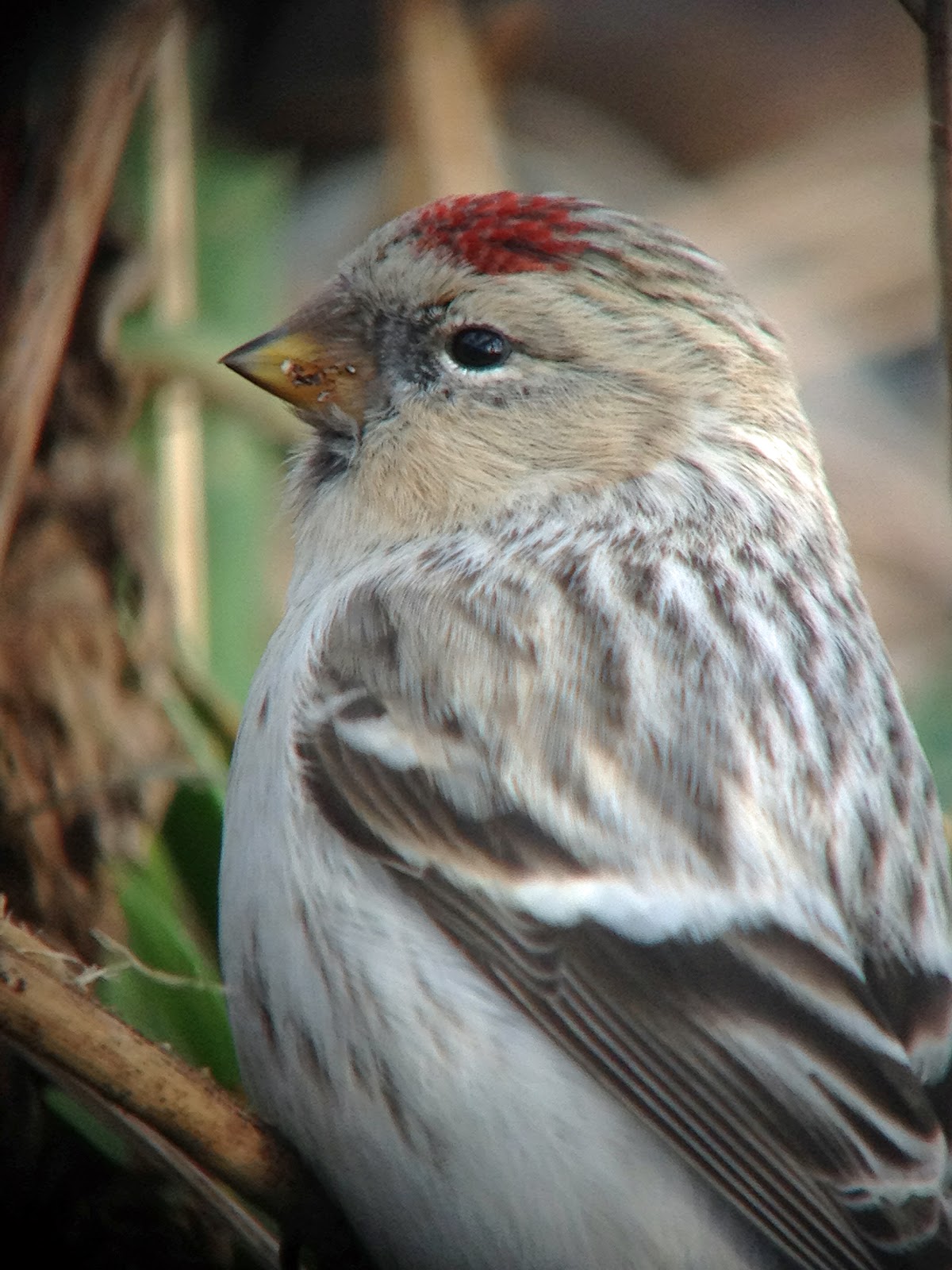
Christian and I started the day at a tranquil Santon Warren, enjoying the array of common birds in the crisp winter air, a singing Reed Bunting and the drumming of Great Spotted Woodpeckers reminding us that spring is still trying to uncoil. A group of eight Bramblings sharing a tree with a Lesser Redpoll, a Siskin and other common birds was a real treat. We walked along the river, seeing three Marsh Tits and two Grey Wagtails before reaching our target area. After seeing a Goshawk fly over, we enjoyed listening to the female Lesser Spotted Woodpecker calling and drumming, managing flight views and a distant look as it fed in the trees. This is the first that I have seen in almost a year! Satisfied, we moved on, calling in briefly at some woodland in Euston, Suffolk, where we heard a Marsh Tit.

Next up was Kelling. We hadn't timed our visit particularly well as the farmer had started working his field, favoured by the redpoll flock, just before we arrived. We eventually tracked a small group of redpolls down though, including at least three Mealy Redpolls and four Lesser Redpolls but there was no suggestion of a Coues's Arctic. Still, it has been a while since I've seen a Mealy and it was a lifer for Christian so we were happy.

Mealy Redpoll at Kelling

At a breezy and cold Happisburgh, scanning the fields south of the lighthouse resulted in us locating the seven-strong flock of Shorelarks, the biggest flock I've ever seen, and we enjoyed distant views as they busily fed before returning to Waveney Forest for another go at locating the Rough-legged Buzzard on the adjacent Haddiscoe Island. This time we were successful. Another birder, Ian, had picked out the bird on the ground miles away and we patiently waited for it to fly to roost, which it duly did, passing quite close to us and allowing superb views. The Barn Owl from yesterday put in a brief appearance but I was even more pleased to pick out a Merlin sat on a gate out on the marsh - another bird I don't see often enough! A Water Rail squeeled from behind us. On the drive back from this wonderful trip we were tuned in to Radio Two as always and Christian was delighted when Liza Tarbuck read out his text detailing our success!

Shorelarks at Happisburgh
.
adult male Rough-legged Buzzard flying to its Waveney Forest roost

Sunday, 1 October 2017

23rd September-1st October 2017

Well, it's been a busy couple of weeks but considering that this has been largely due to a fabulous and quite insane trip to Spurn in the unique company of David D-L and Magnus A, that can't be a bad thing. David and I formed the advance line, stopping en-route on 23rd to mop up the juvenile Red-necked Grebe at Roding Valley Meadows, the juvenile Long-billed Dowitcher at Saltfleet Haven and point-blank views of quality waders at Covenham Reservoir, a tight and showy flock of juveniles including a Red-necked Phalarope, a Curlew Sandpiper, nine Little Stints and two Ruff; a second-winter Little Gull also put in an appearance. The next day, we picked up Mag from the station in Hull...

juvenile Red-necked Grebe at Roding Valley Meadows
torn emotions among Great Crested Grebes at Roding Valley Meadows
juvenile Red-necked Phalarope, just my second, at Covenham Reservoir
juvenile Little Stint at Covenham Reservoir
juvenile Curlew Sandpiper at Covenham Reservoir
juvenile Ruff at Covenham Reservoir
We stayed at Spurn till 30th, the only 'standout bird' for me being the stonking adult male Red-breasted Flycatcher which turned up at The Warren on 27th but I will fondly remember the week for the panoply of common migrants including Yellow-browed Warblers, Redstarts, Whinchats, Spotted and Pied Flycatchers, Wheatears, Whinchats, Bramblings, redpolls, Siskins, Lesser Whitethroats (including a potential blythi at Chalk Bank on 25th), Garden Warblers, hirundines, Tree, Rock and Meadow Pipits, etc. Just one Yellow Wagtail for me, on 25th, which might end up being my last of the year, as might a Hobby on 28th. A Bittern was a nice Spurn tick on 26th. Brent Geese had started to arrive, along with a noticeable arrival of Wigeon and Teal; the common waders are always good value, which strong numbers of Bar-tailed Godwits, Knots, Golden and Grey Plovers, etc, along with the odd Greenshank and Ruff. Spotted Redshank, Little Stint, Whimbrel and Common Sandpiper also made it onto the roll-call. Seeing tonnes of Tree Sparrows was also something of a treat. A very enjoyable and wine-enhanced seawatch on 25th produced a Sooty Shearwater, 15 Arctic Skuas, three Great Skuas, two Manx Shearwaters, 52 Little Gulls and a Black Tern, along with nine Red-throated Divers and a trickle of Common Scoters.

adult ♂ Red-breasted Flycatcher at Spurn
Garden Warbler at Spurn
Spotted Flycatcher at Spurn
Whinchat at Spurn
a no-shits-given Roe Deer at Spurn
We did make a little diversion on 27th upon the incredible news that a SCOPS OWL had been seen at Ryhope, Co Durham; as a big owl fan, and this being a species I've forever longed to see in Britain, I was delighted to be able to soak up views of this bark-plumaged beast roosting in an elder before we heading to the Pennines, near Langthwaite, to sort of Black and Red Grouse successfully, both being birthday lifers for Mag.

dream come true... Scops Owl at Ryhope
♀ Black Grouse near Langthwaite
♂ Black Grouse near Langthwaite
♂ Red Grouse near Langthwaite
The return leg featured a pit-stop at Landguard (my first visit to the reserve since the Short-toed Treecreeper there in 2011) for the Red-throated Pipit which was on the fourth day of its unusually long stay. Also there was a Redstart and a couple of Wheatears.


Red-throated Pipit at Landguard, my second
I was back on patch duty on 1st, a visit which featured the Barn Owl, a couple of migrant Mistle Thrushes, a Stonechat and two Red-legged Partridges... it was a pleasure to bump into Steve G. A call from Christian prompted an unplanned but worthwhile trip to the London Wetland Centre, where we had a quick look from the Peacock Tower, counting Snipe, Wigeon and the like.

Monday, 29 May 2017

Norfolk and Suffolk, 26-29th May 2017

A long weekend in Norfolk with my good pals Magnus A and Christian C was a fine way to sign May, and effectively the spring, off. Over June and July I'm going to take things a little easier, recharge ahead of the autumn and sort out a few things that have brushed aside over the last few weeks! Highlights of our trip included Marsh Warbler at Lakenheath, Savi's Warbler at Hickling, Wood Warbler at Brandon and a singing Quail of our own finding at Icklingham, along with marshland birds such as Cranes, Spoonbills, Bitterns and Grasshopper Warblers. Titchwell provided goodies such as Little Stint, Little Gull, male Ruff, a late Dark-bellied Brent Goose and a count of six Red-crested Pochards. Several Little Terns were seen and further wader action included two relatively late Greenshanks at Cley. Other moments to savour, and to reflect on, included encounters with Grey Partridge, Turtle Dove and Corn Bunting. On the way back, we finally tracked down Stone-curlews in the Brecks.

a purring Turtle Dove at Titchwell on Saturday
my first in far too long... a Grey Partridge near Stanhoe
loud Marsh Warbler keeping out of the limelight at Lakenheath on Friday
Avocet at Titchwell on Saturday
Red-crested Pochards at Titchwell on Saturday... where do they come from?
an endearing brood of Shoveler at Titchwell on Saturday
121 species were noted on the trip, as follows:

Mute Swan, Greylag Goose, Canada Goose, Brent Goose (Dark-bellied), Egyptian Goose, Shelduck, Wigeon, Gadwall, Teal, Mallard, Shoveler, Red-crested Pochard, Pochard, Tufted Duck, Common Scoter, Quail, Red-legged Partridge, Grey Partridge, Pheasant, Fulmar, Cormorant, Bittern, Little Egret, Grey Heron, Spoonbill, Little Grebe, Great Crested Grebe, Marsh Harrier, Sparrowhawk, Buzzard, Moorhen, Coot, Crane, Stone-curlew, Avocet, Oystercatcher, Grey Plover, Lapwing, Little Ringed Plover, Ringed Plover, Black-tailed Godwit, Bar-tailed Godwit, Turnstone, Knot, Ruff, Sanderling, Dunlin, Little Stint, Greenshank, Redshank, Little Tern, Sandwich Tern, Common Tern, Kittiwake, Black-headed Gull, Little Gull, Mediterranean Gull, Common Gull, Lesser Black-backed Gull, Herring Gull, Great Black-backed Gull, Rock Dove (feral), Stock Dove, Woodpigeon, Collared Dove, Turtle Dove, Cuckoo, Tawny Owl, Swift, Kingfisher, Green Woodpecker, Great Spotted Woodpecker, Kestrel, Hobby, Magpie, Jay, Jackdaw, Rook, Carrion Crow, Goldcrest, Blue Tit, Great Tit, Coal Tit, Bearded Tit, Woodlark, Skylark, Sand Martin, Swallow, House Martin, Cetti's Warbler, Long-tailed Tit, Wood Warbler, Chiffchaff, Willow Warbler, Blackcap, Garden Warbler, Whitethroat, Grasshopper Warbler, Savi's Warbler, Sedge Warbler, Marsh Warbler, Reed Warbler, Wren, Starling, Blackbird, Song Thrush, Mistle Thrush, Robin, Stonechat, Dunnock, House Sparrow, Pied Wagtail, (yarrellii), Meadow Pipit, Chaffinch, Greenfinch, Linnet, Goldfinch, Siskin, Yellowhammer, Reed Bunting, Corn Bunting

Tuesday, 17 September 2013

The Great and the Lesser

For the first time in a while, a couple of very tempting rarities turned up over the weekend and got me moving. The more urgent of the two was the Great Snipe at Spurn so I headed up on Monday afternoon after a morning at the patch (which was fruitful for a hurried walk round, providing a Spotted Flycatcher, a Wheatear, the first Siskins of the autumn and a Yellow Wagtail) and arrived in the evening at the caravan site the bird had chosen as a feeding ground. I'd heard the bird was tame but what I saw was just insane, the GREAT SNIPE walking within centimetres of people's lenses and phones, and even walking between someone's legs at one point before crossing the road and going into a ditch as darkness fell! A top bird, and it was very disheartening to learn of its sad demise apparently at the paws of a cat this morning.

Great Snipe

As I'd left the trip till late in the day (thanks exclusively to my compulsion to miss as little patching time as possible), I didn't fancy driving back to Surrey that evening and I still had the shrike to see, so I figured it would be most logical to stay somewhere between Spurn and Sizewell overnight, wait on news and go to see the shrike in the morning before heading home. I found a lovely bed and breakfast on the outskirts of Cambridge and lay in till news came through on the pager late morning of the bird's continued presence. A couple of hours later I parked up and was watching the very freshly-plumaged LESSER GREY SHRIKE. While not as brash as a spring male, the more subtle plumage characteristics along with the structure of the bird made for educational viewing before a heavy shower saw the bird into cover and me back into the car, and back home after a roaring success of forty-eight hours' twitching!

Lesser Grey Shrike

Thursday, 1 August 2013

Norfolk and Cornwall

I've been away for the last few days. First of all I was in Norfolk, on Saturday and Sunday. I didn't really have time to do much birding as such but helped David Darrell-Lambert with a survey, where we found five Stone-curlews, a juvenile female Goshawk and a fair few Crossbills. There with family to see my unce and aunt, we spent Sunday afternoon on their boat on Hickling Broad - picked up a few marshland birds there including a couple of Marsh Harriers and a few Common Terns.

Stone-curlew, just into Suffolk

Early on Monday morning I set off for Cornwall where a couple of days of seawatching were planned with Liam. Arriving at Porthgwarra mid-morning we set up our scopes and began our vigil. It was obvious that things weren't going to kick off and we only managed to pull a couple of Balearics out of the bag. I took this opportunity to catch up on a little sleep and kipped for a while as Liam kept watch. A Chough was a welcome bit of extra interest. Also three Ravens. We checked the Hayle Estuary where there was a selection of common waders including a couple of Whimbrel, decent numbers of Sanderlings and an impressive gathering of 18 Common Sandpipers. Also a couple of Med Gulls.

Tuesday morning the conditions didn't look terribily great but we thought we'd give it a good go and set the alarm for 5.30am. There was slightly more variety with a Storm-petrel and a couple of Puffins alongside Balearic Shearwater, but we only recorded one of this species! I was starting to think this seawatching trip was going to be a disaster when Liam shouted that he had a large shearwater, praying it to be my main quarry I managed to get onto it fairly quickly and indeed it was a Cory's Shearwater! It was quite far, being noticably beyond the Runnelstone but it was enough to see what it was and we had it in view for about five minutes as it headed east; the bird's primaries on one wing were pretty bashed up. Mission accomplished then, Cory's being one of my biggest remaining 'tart's ticks', we packed it in late morning and headed to the Hayle Estuary where we found much of the same as the previous day. That was enough birding for the day for us and we chilled at Liam's flat for the rest of the day, in keen anticipation of what was perhaps to come in the morning, when the weather looked favourable for seabirds.

The alarm was set early once more yesterday morning and as soon as we stepped out of the flat we could tell that we were probably in for a decent watch. We started seawatching from the cove near the car park and Liam, being on fire with large shearwaters, picked up a Great Shearwater heading west - superb! A few minutes later and I located two birds headed past together... things were looking good. About an hour in and we were also into double figures of Balearic Shearwaters and had clocked a couple of Storm-petrels as well as a Bonxie. We moved up to Hella Point where a couple of birders we'd met on Monday had just arrived. It wasn't long before we started picking up the odd Great Shearwater again and the tally steadily increased. Eventually, one bird proved to be a Cory's Shearwater; it was surprising that the ratio of big shears favoured Greats to such an extent. After the other birders left we had another Bonxie, another Cory's and additional Great Shearwaters. The resident pair of Choughs showed well, doing their undulating flight right by us. Martin Elliott and a friend then arrived and after a lull the action resumed, with further Great Shears and another Cory's, this time giving the views that I was after as it lazily toured the waves within Runnelstone distance. This saw me satisfied, I needed to get back home at a reasonable time and Liam wanted to get back to see his friends at his flat to we called it a day shortly before 4.00pm, following a long and productive seawatching shift, perhaps the best seawatch I've ever had. We said goodbye to the other chaps and Liam told them they were bound to get something like a Fea's Petrel now that we were leaving... later that evening I heard less than two hours after we left they picked up nothing other than a bleeding Fea's Petrel... bloody gutting to come that close and I didn't realistically see that coming at the time (though I might have been keen to stay a little longer if I'd known about the three Fea's Petrels in Ireland before we left). That's birding, the high of seeing scarce birds followed by the sinking feeling when you realise what you'd have been treated to if you'd stayed just a little longer......

We finished our birding off with a call in at Hayle on the way back to Liam's flat. Quiet, but six Med Gulls were nice to see. Cheers Liam for the hospitality - most kind!
Monday, 17 June 2013

Recent lifers

The star bird lately was obviously the Pacific Swift at Trimley Marshes. I saw this on Saturday, with the news coming out shortly after 10am. I had just got up and planned a day of revision but there was no way I couldn't go for this. Despite my best efforts and Franko phoning around for me I couldn't team up with anyone but I was fairly confident that being able to drive there at 1.30pm, when my dad was due to finish with the car for the day, would be good enough. I arranged to pick up Dan and Michael Booker and Harry Ramm from Dartford and collected Ian from Wallington, completely filling the car. Once we got to Dartford, the rest of the journey was fairly efficient, but storms and a brief spell of negative news on the bird dampened spirits on the way. The bird reappeared on the pager, though, prompting a cheers and a slightly heavier foot on the gas.

On arrival it was evident that getting to the precise viewing location was going to be a miserable affair and we got soaked immediately. I think the walk was a little under three miles each way and we were treated to a complementary hailstorm for much of the trek. I hadn't eaten in hours, was soaked to the skin and feeling utterly miserable. Knowing such weather can see swifts off, I didn't want to ask returning birders for the latest news as I approached, although I felt so crappy that I didn't think seeing the bird would be the buzz that it should. Eventually we got to the river wall overlooking the marsh and the PACIFIC SWIFT was picked up as the weather began to soften - I was very wrong about the buzz being killed, this was one absolute cracker and I no longer cared how long it would take for my socks to dry, or that I would have to drive home with a wet arse. The bird cruised back and forth across the marsh at its leisure, allowing intimate scrutiny of its features through the scope and opportunities for photographs. Happy happy happy! A summer-plumaged Spotted Redshank and a Yellow Wagtail were good back-up birds alongside the Avocets, Oystercatchers etc. I just about managed to get Dan, Mike and Harry back to Dartford in time for the train and Ian and I got home some time around 10.15pm. Ta for the company!


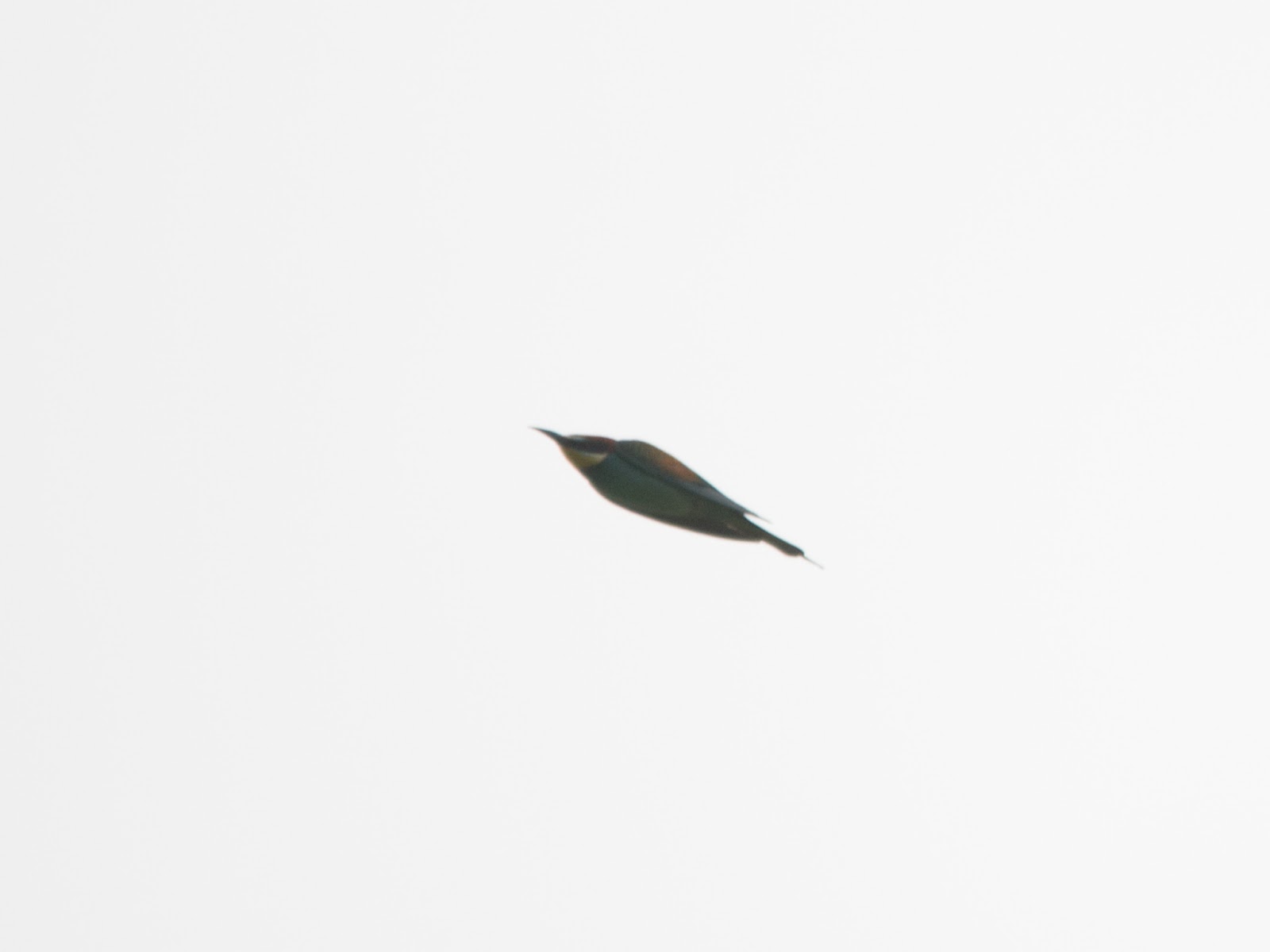
On Sunday 9th May, I picked Ian up and we headed Kent-bound for the Bee-eater that was present for its second day at Pegwell Bay Country Park. I had only been to the place once before, where I saw the Zitting Cisticola (all of its congeners are called cisticolas, so I don't see why we should call this one 'Fan-tailed Warbler' so that it can fade into the pages with the acros, phylloscs etc ... even though it's a slightly naff name). We joined the end of the crowd when we found the right place, the bird apparently being close and in the open in a small bush, but it turned out that we couldn't see it from where we were standing. By the time we reangled and just about got on it, the Bee-eater took flight, right over our heads. It proved mobile but a couple of hours on site were rewarded with prolonged flight views and some distant looks at it perched prominently atop tall hawthorns and the like. It was nice to catch up with Neil Randon there.


Even though Ian didn't need Black Kite, I did, so on the way back we stopped near Selling and got onto the Black Kite cruising slowly over the valley with surprisingly little trouble. We left it in the same bit of sky that we first saw it in, after the passing of at least half an hour! I'd seen these abroad but not for ages and Britain is what matters for me so this was like a totally new bird and it was great to have a long look at what made it a Black Kite, in a British setting.


My exams are all over now so I can thankfully return to birding without such pains that normal life brings, for a few months at least.

Tuesday, 28 May 2013

Getting Savi

Yesterday I shared an enjoyable trip to Lakenheath in the evening with Phil. He was in it for the long-staying male Red-footed Falcon which, despite his recent extensive travels, he hadn't seen anywhere in the world. I came for the Savi's Warbler, a bird that I haven't had the chance to chase yet.

On arrival we heard that the falcon hadn't been reliably reported since mid-morning and that the Savi's hadn't yet starting its evening singing session. Walking towards the area of interest, we passed a large group of people intently peering into a plantation. We took a few guesses as to what the attraction was but they were all incorrect... it turned out to be the most obliging male Cuckoo that either of us had ever seen! It put on a superb show, perching for long periods in good light in between diving into the undergrowth in pursuit of large caterpillars.

Cuckoo
There were large numbers of Common Swifts, and a single House Martin, taking advantage of the abundance of emerging insects but we only saw two Hobbies. A Bittern boomed from the reeds while one or two cream-crown Marsh Harriers quartered the fen and a Cetti's Warbler sang from another plantation. I joined the gathering waiting for the warbler while Phil remained further back in case the falcon showed up. I had arrived just on time as the bird had apparently started singing very recently and I didn't have to wait long before it gave a burst of reeling, similar to a Grasshopper Warbler but heavier and more metallic in sound. It was instantly apparent that seeing the bird might be an entirely different challenge as the persistently powerful breeze promised to keep any warbler in the sheltered under-storey of the reedbed, although it didn't put off a particular male Reed Bunting which maintained its proud position atop one of the most exposed perches.

The bursts of singing grew longer and more regular, giving us more of a clue as to where the bird was. Phil rejoined me at this point and a collective penetrating stare into the rustling stems by the assembled crowd reaped the reward when the SAVI'S WARBLER appeared near a close-by bush. This first view was brief, but good enough for the tick. I did want further views though to fully appreciate the bird and its identifying features, and to hopefully get some images so we continued to stake it out. It soon reappeared, perching quite obviously in the said bush and this allowed all of its features to be scrutinised. The bird was a rich, warm, intense brown and had a large, fan-shaped tail - both features reminiscent of Cetti's Warbler. The undertail coverts were extensive, washed light greyish-brown with pale tips just noticeable. The breast and flanks were washed a similar greyish-brown to the vent and undertail coverts and the bill struck me as rather long and spiky. The wind died down and the evening progressed, but the light was still good and so the bird ended up giving prolonged showings on a number of occasions, making me a very happy man indeed. A Kingfisher dashing past was a nice touch. Ta, Phil.

Savi's Warbler

Sunday, 9 December 2012

The best redpoll ever

For best viewing, click the cog icon, select '1080p' and also choose the full-screen option


Liam's been staying with me at the weekend for some birding (see yesterday's post for our first outing) and when a HORNEMANN'S ARCTIC REDPOLL came through from Suffolk in the middle of dinner, we were erring as to whether or not to go. It was a bit of a way and we were looking forward to a relaxed day staying local. We started today at Banstead Downs Golf Course, locating at least one of the wintering Firecrests and both independently hearing a 99%-certain Waxwing calling once as it passed over, maybe a hundred feet up. It was then that the redpoll came on the pager; I called Ian to see if he was up for it, and picked him up. We very briefly stopped on Canons Lane to allow Liam to Canons-tick Lapwing, which was a success. A good sign!

The journey was remarkably smooth and we got to Aldeburgh in about two-and-a-half hours. It took me a while to get ready and by the time I started putting my camera over my shoulder and locking the car Ian and Liam had seen the bird well and watched it fly off! Not to worry, though, as it was soon relocated and it didn't exactly prove a challenge to get on or get clear views of, showing virtually no fear of the several-dozen birders admiring it. A true beauty, allowing both its overall striking appearance and more precise features to be observed in exceptional viewing conditions. Happy all round, with no reason for angst about photographers or people getting too close as the bird simply did not care.